
Top Civil Asset Forfeiture Legal Defense
Under civil forfeiture, law enforcement can seize cash, vehicles, and other property on suspicion, even when prosecutors haven’t filed charges. In many cases, authorities do not arrest anyone and do not file criminal charges at all. The government seizes property upfront, leaving the owner to fight for its return.
These cases move quickly and quietly. Deadlines are short, procedures are rigid, and many people lose their property simply because they do not understand how the system works.
We represent individuals whose property local, state, and federal agencies have seized through asset forfeiture proceedings. Civil forfeiture is not a side issue. It is a high-stakes legal battle that requires immediate action, procedural precision, and a defense strategy designed to force accountability from the government.
Types of forfeited property, DOJ revenue-generating forfeitures, 2000–2023
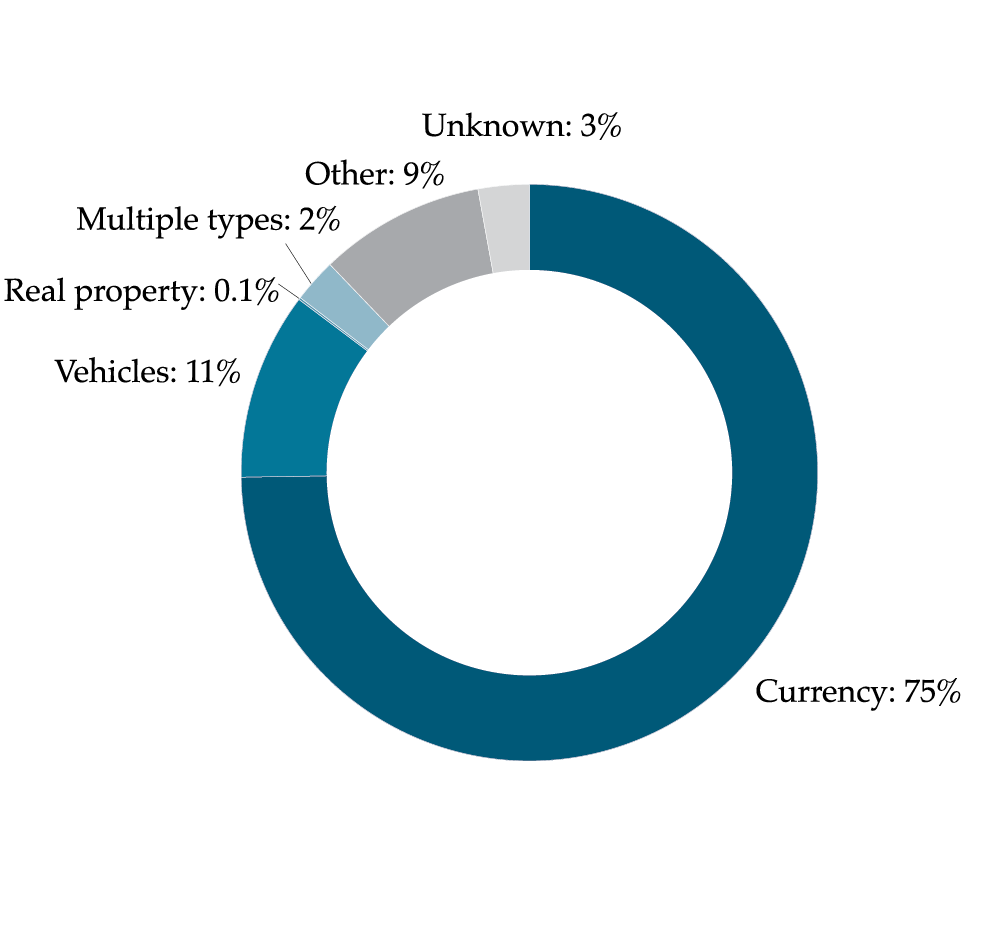
Source: Institute for Justice, Policing for Profit: The Abuse of Civil Asset Forfeiture, 4th Edition (“What Is Forfeited?”, Figure 18).
What Happens Early in a Civil Forfeiture Case
Civil forfeiture often begins during a traffic stop, airport encounter, or investigation tied to alleged criminal activity. Law enforcement may seize cash, vehicles, or other property if broad claims connect them to illegal conduct.
Once the government takes the property, it initiates forfeiture proceedings by issuing a notice. This notice triggers strict deadlines. If a claim is not filed correctly and on time, the property can be forfeited permanently without a hearing and without any determination of guilt.
Defense counsel preserves right to contest seizure, identifies deadlines, and determines whether state or federal law applies to the forfeiture. Missing this window can end the case before it ever truly begins.
How Law Enforcement and Prosecutors Justify Forfeiture
Civil forfeiture operates under a lower standard than criminal cases, often running parallel to drug investigations or other allegations. Agencies often rely on circumstantial factors rather than direct proof.
Common justifications include:
- Large amounts of cash allegedly inconsistent with travel plans
- Canine alerts claimed to indicate drug residue
- Alleged inconsistencies in explanations given during questioning
- Associations with ongoing investigations, even without charges
The government treats the property as the accused, and authorities link assets to crime, though authorities have not arrested the owner.
Equitable sharing programs further complicate these cases by allowing agencies to retain a portion of seized assets. Through these programs, agencies may retain a significant portion of forfeited assets, creating financial incentives to pursue seizures aggressively.
Where Civil Forfeiture Cases Fall Apart
The government must prove a real connection between the property and alleged criminal conduct under Illinois forfeiture law, causing civil forfeiture cases to weaken. Unsupported assumptions, weak canine evidence, and lack of probable cause are common vulnerabilities.
Other breakdowns occur when agencies fail to follow statutory requirements, provide improper notice, or rely on unlawful searches. Agencies identify procedural violations and can challenge or dismiss forfeiture claims entirely.
Once the government defends the seizure in court, leverage often shifts. Many agencies are unprepared to meet that burden.
Why Timing Matters in Civil Forfeiture Defense
Civil forfeiture is driven by deadlines, not discretion. Missing a filing date or submitting an improper claim can permanently forfeit property, regardless of the facts.
Early legal action preserves the ability to challenge the seizure, demand evidence, and force the government to justify its actions. Delay almost always benefits the agency holding the property.
If your cash, vehicle, or property has been seized, waiting can cost you everything.

Best Criminal Defense When It Counts The Most
The attorneys at Edward Johnson and Associates P.C. take pride in providing a complete legal defense team for our clients.
With over 200 client five-star reviews, our firm is a top-ranked criminal defense and civil asset forfeiture law firm in Illinois. A comprehensive legal defense team is essential for effective case defense.
Understanding Civil Forfeiture Under Illinois and Federal Law
Civil forfeiture may be pursued under Illinois law or federal forfeiture law, depending on the agency involved. In some cases, state or local agencies transfer property to federal authorities to take advantage of federal forfeiture rules.
Each system has different procedures, deadlines, and defenses. Understanding which laws apply is critical to building a strategy that works.
Civil forfeiture cases are not criminal prosecutions, but the consequences are very real. Property owners have rights, but those rights must be asserted correctly and on time.
Cash Seizures, Traffic Stops, and Airports
Many civil forfeiture cases arise from traffic stops or airport encounters. Law enforcement often targets travelers carrying large amounts of cash, particularly at major transportation hubs.
Officers may question individuals about the source and purpose of the money. Regardless of how questions are answered, cash is frequently seized based on claimed suspicion alone.
These cases often involve canine alerts and rapid seizures, followed by release without arrest. The fight over the money happens later, through forfeiture proceedings that most people are unfamiliar with.
A Defense Strategy Built for Forfeiture Cases
Civil forfeiture cases require a defense that combines procedural precision with aggressive litigation. These cases often run parallel to criminal investigations, making it critical to protect both property and constitutional rights at the same time.
At Edward Johnson & Associates, P.C., we approach civil forfeiture cases with the same seriousness as major criminal matters. We prepare to challenge the seizure, contest the government’s evidence, and pursue recovery through every available legal channel.
Speak With a Civil Forfeiture Defense Lawyer Today
If your cash, vehicle, or property has been seized by law enforcement in Chicago or anywhere in Illinois, time matters. The earlier we step in, the more control we gain.
Call 708-606-4386 to speak with Edward Johnson & Associates, P.C. and schedule a confidential consultation. When your property and financial future are on the line, you need a defense built on strategy, precision, and relentless pressure against the government.
We go up against the following government agencies, among others, to get your cash and other assets back.
 ATF |
 CBP |
 DEA |
 USPIS |
 US Attorney’s Office |
 State/Local PD |
 FBI |
 IRS |
 Secret Service |